BENTONITE BUYING GUIDE
Bentonite Buying Guide: Grades, Tests and Specifications
Learn how to compare bentonite grades, read test reports, evaluate samples and specify packing before placing an industrial bulk order.
Start with the process, then choose the bentonite
Bentonite is not a single interchangeable powder. Two offers can share the same product name and still behave differently in water, during mixing or inside a finished formulation. A useful bentonite buying guide therefore starts with the application rather than the lowest price per tonne. Tell the supplier what the material must do, how your operation will use it and which results define an acceptable batch.
The US Geological Survey describes bentonite applications including drilling fluids, foundry binders, iron ore pelletizing and absorbents. These uses depend on different properties. A material that performs well in one process should not be assumed suitable for another. Build a purchasing specification around your own process, then ask suppliers to respond to that specification with traceable evidence.
Understand sodium, calcium and activated bentonite
Sodium and calcium bentonite are common commercial descriptions. The University of Waterloo distinguishes sodium bentonite by its swelling behavior and calcium bentonite by its much lower swelling behavior. That difference helps explain why buyers need more than a general clay description. It does not, by itself, establish whether an offered material will meet your industrial requirements.
Ask whether the proposed product is naturally sodium bentonite, calcium bentonite or an activated material. If it has been treated, request a description of the treatment relevant to your application. Also ask whether additives are present. Record the answer in the agreed specification rather than relying on a sales conversation that may not accompany the next order.
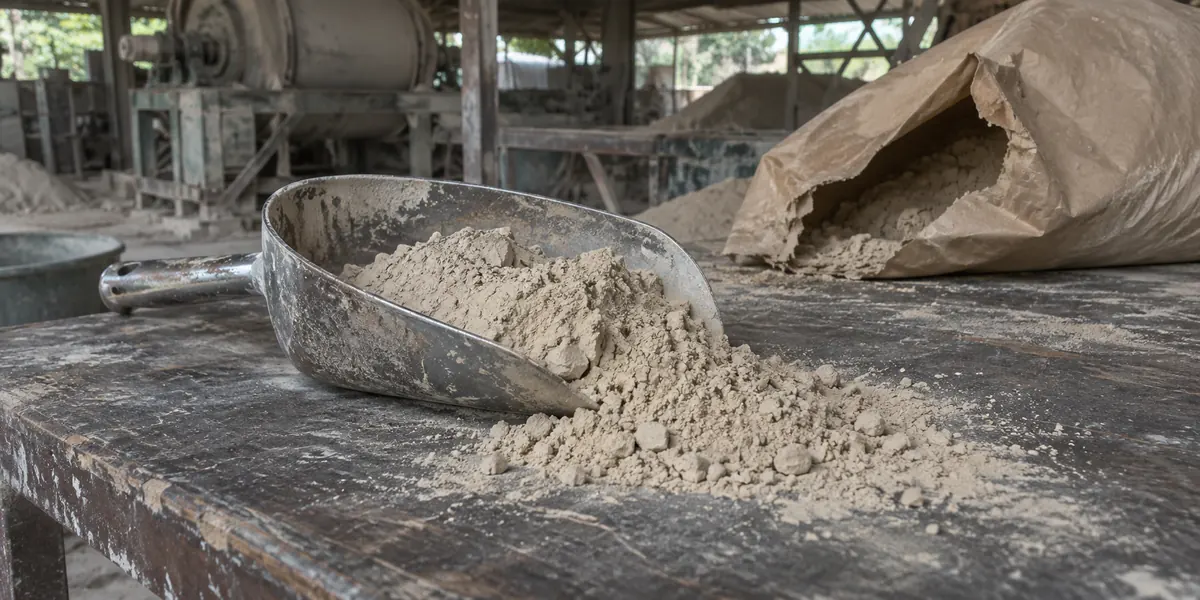
Avoid choosing solely by color or a photograph of dry powder. Appearance may help identify obvious differences between samples, but it cannot demonstrate swelling, fluid performance or consistency. Keep visual observations separate from laboratory results and process trials.
Turn your application into measurable requirements
For drilling-related use, your technical team may require defined rheology and filtration tests. For foundry use, it may focus on bonding behavior under the intended sand-system conditions. An absorbent application may instead prioritize granule size, liquid uptake and dust. Describe the outcome you need before deciding which individual measurements belong in the purchase contract.
If your specification refers to API, OCMA or another published standard, identify the exact document and edition. A label such as “API bentonite” is not a complete test report. Ask which tests were performed, which methods were used and how the results compare with your stated acceptance criteria. Do not substitute an unspecified claim of compliance for those details.
Where a supplier proposes an alternative test, ask your technical reviewer whether the result is comparable. Different preparation procedures can make apparently similar numbers difficult to interpret. Resolve that difference before treating one offer as technically better than another.
Read the certificate of analysis as a batch record
A useful certificate of analysis should identify the product, batch or lot, sampling date, test methods, units and reported results. Check that the document relates to the material being offered. A historical example can show the format of a supplier's reporting, but it cannot establish the properties of a future shipment.
Separate guaranteed limits from typical values. A typical moisture result or average particle-size result describes an observation; a contractual maximum or minimum defines an acceptance boundary. Ask the supplier to mark which values are guaranteed and how a nonconforming result would be handled. This prevents a familiar data sheet from becoming an ambiguous purchasing specification.
Review missing information as carefully as the numbers provided. If a report uses “pass” without a method or acceptance limit, request clarification. If several batches are being combined, establish how the reported sample represents the combined delivery.
Specify particle size and moisture on a clear basis
Particle size influences how a buyer handles and incorporates a powder or granule. Specify whether your requirement is a sieve result, a percentage passing a named screen or a measured size distribution. Include units and the test method. A mesh description without its reference or passing percentage can leave important room for interpretation.
State whether quoted quantities and analysis are on an as-received or dry basis. This matters when comparing materials with different moisture contents. For an illustrative calculation, 1,000 kilograms of material at 10 percent moisture contains 900 kilograms of dry material. That example is a comparison tool, not a recommended moisture limit for any bentonite application.
Ask how moisture is checked and how the packing protects the product during the proposed route. Your operation should set the acceptable limit based on its process and handling requirements.
Use a controlled sample trial
Agree what the sample represents before dispatch. Record its reference, quantity, packing and connection to the proposed production lot. Retain enough material for your planned checks and, where practical, a reference portion. A small unlabelled bag is difficult to connect to a later shipment if performance questions arise.
Test under conditions that resemble your operation. Record water source, mixing sequence, dosage, preparation time and other variables that your technical team considers relevant. Change one variable at a time when comparing alternatives. Otherwise, a difference in sample preparation may be mistaken for a difference between suppliers.
Write the trial conclusion against the original criteria. “Looks good” is less useful than a record of measured results, observed handling behavior and unresolved questions. Sample approval should feed into the shipment specification, not replace it.
Match packing to the receiving operation
Choose bagged or bulk delivery around the equipment at both ends. For bags, define net weight, construction, lining, closure, pallet arrangement and identification. For larger packs, confirm that lifting and discharge arrangements suit the receiving facility. Include any restrictions on maximum unit weight or available unloading space.
Ask for a packing list that connects quantities and lot references to the shipment. Establish how damaged packs, missing labels or signs of water exposure will be documented at receipt. A straightforward receiving procedure helps the purchasing, warehouse and technical teams work from the same evidence.
Storage instructions should come from the proposed product's supplier and your site's operating requirements. Keep those instructions with the purchase record so they remain available after the inquiry has moved into routine replenishment.
Compare the complete offer and prepare your inquiry
Compare offers only after aligning product type, acceptance limits, quantity, packing and delivery point. Separate the material price from freight, inspection, handling and other agreed charges. If two quotations use different quantity or moisture bases, normalize them before making a commercial decision. A cheaper tonne is not necessarily a cheaper usable input.
For a clear bentonite inquiry, bring together the application, required material type, test methods, acceptance limits, particle-size requirement, approximate tonnage and destination. Add your sample-review plan and preferred packing. Identify which requirements are essential and which remain open for discussion.
Use the ADA bentonite product page as the next step in that conversation. A concise written brief gives the proposed supplier a specific question to answer and gives your own team a consistent basis for technical review, purchasing approval and receiving checks.