FLUORSPAR BUYING GUIDE
Fluorspar Buying Guide: CaF2 Grades and Quality Checks
Compare fluorspar grades, CaF2 analysis, impurities, sizing and shipment checks to build a clear specification for industrial fluorite purchases.
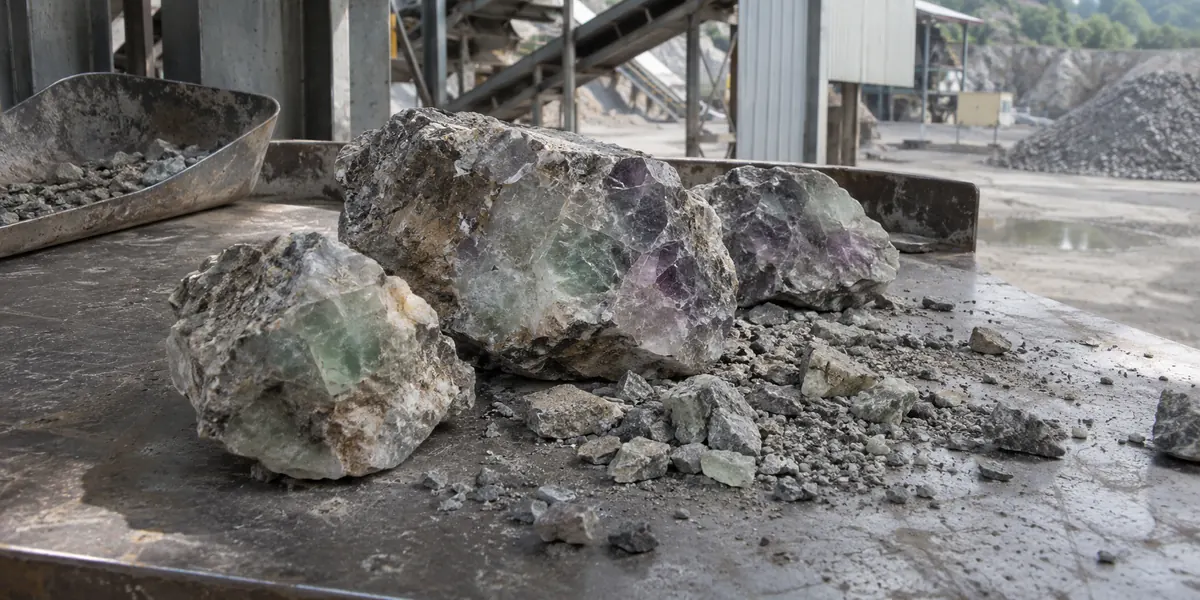
What industrial buyers mean by fluorspar
Fluorspar is the commercial name commonly used for fluorite, the mineral calcium fluoride, written as CaF2. In an industrial inquiry, however, the product name is only the beginning. Buyers also need a grade, chemical limits, physical form and a clear connection between the analysis and the shipment. Those details determine whether an offer deserves further technical review.
This fluorspar buying guide explains how to structure that review without confusing a broad market category with a guaranteed specification. Whether you are comparing lump material or a fine concentrate, start with the requirements of the receiving process. Then request evidence against those requirements, rather than asking different suppliers for their interpretation of “good quality fluorite.”
Distinguish the main commercial grades
The Montana Bureau of Mines and Geology describes acid-grade fluorspar as material above 97 percent CaF2, ceramic-grade material in an approximate 85–97 percent range and metallurgical-grade material around 65–85 percent. These are useful descriptions of market segments. They should not be treated as universal purchase limits for every plant or every contract.
The same fact sheet connects acid-grade material with hydrofluoric acid production and metallurgical-grade material with uses including steelmaking flux. The purchasing implication is simple: identify your application before choosing a grade description. A plant's acceptance criteria may include narrower limits, additional impurities or a particular physical form that the category name does not express.
Do not assume that a product described as suitable for one industrial use is suitable for another. Ask the responsible process engineer to approve the complete specification before commercial comparisons move forward.
Make CaF2 content a defined contractual value
An offer stating “CaF2 85 percent” leaves several questions unanswered. Is that a minimum, a typical result or an individual sample measurement? Was it reported on a dry basis? Which analytical method was used? Does the result describe the stock currently offered or a general product family? Ask for these distinctions in writing.
Create separate fields for the guaranteed minimum and the measured result. That lets your team see whether the proposed material satisfies the contract and how much variation may be present. If a seller provides a range, clarify how each shipment will be accepted and whether different lots will be supplied under one order.
For an illustrative comparison, a dry tonne at 85 percent CaF2 contains 850 kilograms of CaF2. The arithmetic can help compare offers, but it does not account for process suitability, impurity effects or recovery. Do not let a single normalized number replace technical approval.
Review impurities alongside the headline grade
Ask your technical team which non-CaF2 components matter to the receiving process. The purchasing sheet may need fields for silica, carbonate-related components, sulfur, phosphorus or other parameters selected by that team. Request results in the same units and on the same reporting basis from every supplier.
Avoid copying a long list of limits from an unrelated offer. A specification becomes useful when each limit has a defined purpose and a reviewer who can assess it. If an element or compound is not reported, mark it as missing rather than assuming that an unlisted result is zero.
Discuss how out-of-specification findings will be resolved before shipment. Clarify whether confirmation testing is required, who selects the laboratory and how the parties will identify the material under review. These practical questions are easier to settle while the order is still being planned.
Specify lumps, fines and particle-size distribution
State whether you require lump fluorspar, gravel-like material or a fine concentrate. Then translate the preferred form into measurable size requirements. Include an acceptable size range and any agreed limits for undersize or oversize material. Ask how the distribution is measured and reported.
Photographs help explain the intended appearance, but they cannot replace a size analysis. A close-up without a scale may make different materials look similar. Request both an overall view and a measurement-based report, especially when feeding, screening or dust management depends on the delivered size.
Discuss how handling could affect the size distribution between sampling and receipt. If your operation has a particular sensitivity to fines, make that part of the packing and receiving conversation. Agree the point at which the contracted size requirement will be checked.
Connect sampling, analysis and the actual lot
A credible review needs an identifiable lot. Ask for the lot reference, available quantity, sampling date and a description of the sampling procedure. The laboratory document should connect to that reference. A report with impressive figures is less useful when nobody can explain which material produced them.
Agree how a representative sample will be collected and whether retained portions are needed. The approach should suit the material and the commercial risk of the order. A handful selected for appearance should not be treated as equivalent to an agreed representative sampling procedure.
For a first order, use the sample to answer specific technical questions. Record test conditions and acceptance criteria. After review, translate the approved characteristics into the purchase specification so the shipment is assessed against a shared written basis.
Clarify moisture, packing and quantity
Distinguish net product weight from gross shipment weight and identify whether the commercial quantity is as received or adjusted to a dry basis. Ask how moisture is measured and whether a maximum is guaranteed. This helps prevent apparently equal per-tonne quotations from using different quantity assumptions.
Specify bag construction, net weight, lining, closure and pallet requirements where applicable. For bulk delivery, describe the loading and unloading arrangements you want reviewed. Tell the supplier about equipment limits at the receiving location rather than assuming the standard packing will fit.
Ask how each package or bulk lot will be identified. Keep the packing list, analysis references and transport documents consistent so the receiving team can reconcile what arrives with what was approved. Discuss how wet, damaged or unidentified packs will be recorded.
Build a comparable quotation and receiving plan
Put each proposal into the same comparison sheet: product form, guaranteed CaF2, agreed impurities, size distribution, moisture basis, net quantity, packing, price basis and delivery point. List testing and inspection costs separately where they are not included. Identify the proposed schedule and the conditions that could change it.
Before approval, prepare a short receiving checklist covering lot identity, package condition, quantity and the required documents. Define who can release the material for use and who should handle discrepancies. A technical specification has more value when the warehouse knows how to connect it to the arriving shipment.
To discuss fluorite with ADA, include your application, target grade, required analysis, particle size, quantity and destination. Add the sample plan and packing preference. That brief creates a practical foundation for reviewing the proposed material and comparing a complete offer rather than a headline percentage alone.